
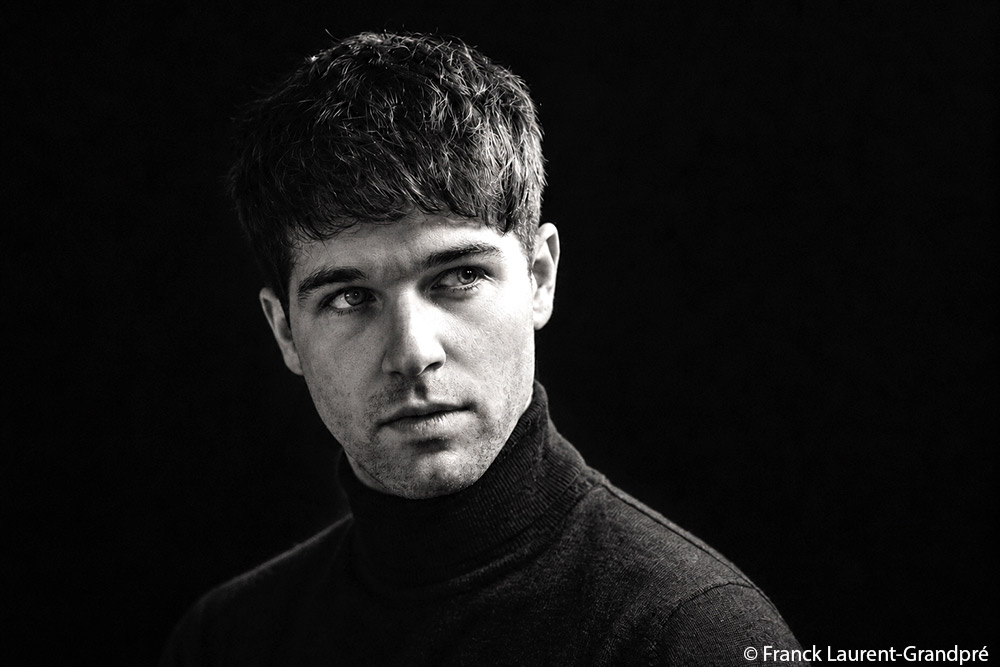
Sublime and so beautiful. As soon as he appears and a note of his appears, in the middle of the delicate candles that watch with us, in the here and now. Creator at heart, gifted artist, composer of genius, words fail to describe Franck Laurent-Grandpré, this virtuoso pianist who sets hearts on fire, and literally knocks down the halls with each of his concerts. What is his secret? An exceptional technique, a remarkable musicality, which he forged in a dazzling course, and by meeting giant mentors… Or his deep sensitivity, and this pure ingenuity which colors each of his interpretations and compositions, taking us into another time , and to the source within, where we remain speechless before so much grace.
Dedicated to the piano
Was he predestined? The youngest of three children, Franck was born into a family of lawyers; a father of Reunionese origin, a mother of Czech origin, and with a childhood in the flowery heights of Lyon. He never experienced any music because “the only one we listened to was current music, that of television shows”. A sign, however, was given, because his mother, pregnant with him, had this compelling desire to go and listen to sacred music in churches, with her CD player and headphones on her head ! Franck was a hypersensitive child, and we could find him in the playground chatting with his teachers, or within a small group of friends, playing Magic cards or Warhammer. “I loved escaping into the imagination, with epic adventures, fascinating characters and fantastic worlds.” One day, during a musical awareness class where the whole class had to bang pots and pans, the little boy came away so traumatized that he could no longer speak for several days. His parents then decided to send him to school in a more suitable environment, and it was around the age of 9 that he joined “Les Petits Chanteurs of the Primatiale Saint Jean in Lyon”. “My ear was educated there, with choral singing at a good level.” He also tours internationally, now immersed in the world of art music.
Then came this turning point around the age of 13. “There was a little synthesizer at home, put aside in a storage room, and I came across it at Christmas.” Immediately, as he improvised music, his parents offered him for the holidays, a keyboard with lighted keys. His mother remains speechless because, after three days, he was already playing the pieces without having to use the lights. “This is how the piano entered my life, and was an obvious partner for me. I then started taking lessons and everything went very quickly…”

The musical rise

It’s time for all the challenges. During a recital of Rossini’s Petite Messe Solennelle, the young teenager approaches the pianist François-René Duchâble, known for having dropped his piano in a lake. “As he had a great international career, he will try to discourage me from doing this job, because of all the time lost in travelling. But it didn’t work!” A few weeks later, with only six months of intensive piano training, Franck Laurent-Grandpré will attempt to perform the third movement of Beethoven’s Moonlight Sonata on the piano. “It was very moving, because despite all my imperfections, the conductor didn’t want to believe that I was just starting to turn the piano, and he introduced me to Bruno Robillard, a professional pianist, who started help me.” The young musician then entered the National Regional Conservatory of Lyon, with this incredible potential. “The jury threw this sentence: the interpretation of the middle of the piece was exotic, but the performance of the impromptu is good. There, I really started playing the piano, and after three years, I won the medal at the regional conservatory.”
He obtained it with the best honors, and continued his studies at the Haute École de Musique in Geneva, taking doctorates in Florence, Catania and even at the Royal Birmingham Conservatoire… And yet another revenge, since Franck will finalize his musical course, with First prize and Congratulations from the jury, at the Conservatoire National Supérieur de Musique de Paris, the “grail” in this profession. He is now in the big league and carrying in his hands and his memory, a pure treasure that he will continue to work on and develop, obtaining the highest awards in the most prestigious international competitions. “It is said that it takes 20,000 to 30,000 hours to master your instrument. So almost 10 hours of piano for 10 years, every day. And indeed, with the competition periods as an intense accumulation of work, that’s pretty much what I had to do, spread over all these years.”
The decisive encounters
At the beginning, the young student will look for teachers who will give him confidence in order to be accredited in this profession. Then through meetings and travels, some will lastingly shape his mode of expression. Like with Maria João Pires with this internship in a Buddhist institute, teaching an improbable mix between music seminar and spirituality.“We got up at 6 a.m. to go make improbable Buddhist vocalizations in their satsang, and then we played the piano in a family chalet, perched in the middle of the mountains.” There, he will remember that true music always has its absolute source deep inside, and within ourselves. Denis Pascal will also be in his wake to teach him how to dance the piano,“that is to say, to play music like a dancer”.And again Jean-Claude Pennetier, a somewhat austere Orthodox priest,“but an incredible musician, and of unparalleled kindness.” Until today, the pianist from Lyon has kept this discipline by working every day, Saturday and Sunday included, to keep in mind the approximately 15 hours of repertoire that he still wishes to develop.

Two memorable encounters, polar opposites of each other, will also mark him forever. First Elisso Virsaladze, the great sacred monster of the Russian Soviet piano, who agreed to give him lessons in Fiesole. Obviously, with little room for fantasy, since she embodies absolute authority,“ but she is in truth an incredible teacher, coupled with an adorable person, who speaks 9 languages, and who teaches everyone in their language, setting an example of discipline to be maintained.”A perfect technique therefore, and a military pedagogy which the pianist will confront, and from this discomfort allow magic,because being terribly framed by it, with its very specific requirements, I was forced to look far in my creativity to find my space of freedom.”It is also there that he will integrate sensual touch into his art, and playing piano, very small, very fine, with perfect mastery of pianissimos and agogic.
The second meeting will be with the Cuban pianist, José Luis Prats,“one of the living pianists I admire most in the world.He came to Lyon when I was at the Conservatory, and it was the most beautiful recital of my entire life, because there was a sound that filled the entire auditorium, and even at the back of the hall, I delighted every each of his notes, and of his improvised playing.” There again, he will find himself face to face with the mentor, during a prestigious competition. ”An imposing man, with his dark and intimidating gaze, and he hit me on the chest and shouted: Of course I remember you. You played like garbage! because he didn’t vote for me.” But he will allow me 15 hours of personal lessons on the sidelines of the competition, and offer me a timeless moment… to play immense, to play free, enormous and with the indirect transmission of the precious advice of Arthur Rubinstein who had trained him, in particular on the mastery of time and how create a colossal sound.“He completely freed me from the way one could touch a piano, and exploded the frameworks of what I could have conceived!”
Creativity without limits

Multi-potential, Franck is also keen on philosophy, religions and spirituality, passionate about alternative medicine, evolutionary astrology, Latin music and capoeira… which allows him to explore many possibilities, and create new with his full visions, assembling so many different things that bring out outsider creativity. “These are always cycles, contexts, associations of ideas which will generate a creative imperative.” His many projects are therefore under construction, like an adventurer’s saga. In 2017, he started a work for piano entitled“The Sagrada Familia”.“I decided to try to build a kind of musical cathedral, hence the name, with an infinite variation of an initial motif, on which everything is built.” It is a hymn to life, and all the influences are present, in an odyssey in three parts, whose main trinitarian motif is varied in three themes: E Flat, D major and B minor, which are respectively the Mystery, Tenderness, and Creation. This somewhat mysterious work already includes 3 hours of composition, with a breathtaking palette and diversity of colors, and, good news, the first chapter will finally be revealed in full this summer, on the occasion of the 2024 Olympic Games.
The pianist is also an extraordinary performer, with nearly 200 solo recitals given around the world over the past 4 years, and he is currently traveling the cities of France, to delight the public with his revisited interpretations: Chopin, Hans Zimmer, Beethoven, Mozart, Einaudi, Tiersen… and his paraphrases and piano transcription of film masterpieces. Perhaps one day he will find enough time to transmit his art,“certainly from what I would do at that time, since the best teachers are those who practice what they teach.” And always design musical experiences, thinking outside the box.
Franck Laurent-Grandpré is a generous and humble artist, and for sure a comet in the world of classical music, surprising with the audacity, purity and excellence of his projects. And giving himself without measure, in an overflowing creativity that rises to the firmament! But what deeply marks us about this prodigy, whose career is on the rise, is his sincerity, the clear vision that he carries within him, and the true love that is offered in everything he does. This is probably why we experience an interior journey at each of his concert, where creative music is transformed into curative music, and in mediator between the deep silence that he listens to, and that which he awakens in us, source and origin of all sounds. It is from this beauty that a better world will come! Let us therefore follow with delight the luminous trail that he leaves in our consciences at each of his passage…
Texts and photos are the personal creation of ©Carine Mouradian following an exclusive interview with Franck Laurent-Grandpré on May 26, 2024 – All rights reserved.
Link to the website of Franck Laurent-Grandpré
Photo Gallery of Franck Laurent-Grandpré
The vision of authenticity by Franck Laurent-Grandpré, beauty will change the world
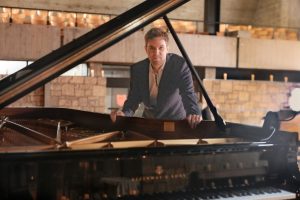
“I immediately liked the piano, because it is very complete. It’s a full orchestra! And what fascinated me from the start was the whole universe that we can make appear with just this instrument. I was fascinated by the great pianists, and that a person could experience a whirlwind of sensations and penetrating emotions, while sitting, with just the movement of his hands on the keys. And how amazing it is to be able to achieve transcendence with matter! Often we oppose matter and spirit, but the mastery of matter creates spirit; and the spirit comes to work and fertilize the matter in parallel. With the piano, we touch on this alchemy, this communication between the two. When we work on musical material, it will refine our mind. Then, the mind will be able to be even more refined and work on the material, and this is what we feel in the playing of Horowitz or that of Cortot, who are two pianists who literally fascinate me, because they create magic with sound, in a pure creative game, which is the ultimate quest of every artist.
I often say that music is sound and only sound… It’s true, but to make the absolute vision palpable, it’s much more complex than that. The truth is I am in total frustration with my piano, because there is an ideal of Beauty that I want to achieve, but I am faced with working on the material which can only respond to it if we constantly train it, like a top athlete. This path, where everything is possible, is endless. As a beginner, we will have a tendency to tense up, to hit a chord a little loudly, and we will remember having difficulty moving two fingers! And then one day, we make ten sounds superimposed on each other; by controlling their duration, their rhythm, their placement in time, and the intensity of each of the notes which follow one another in the service of expression. So, we must always remember that with time and work, what was totally inconceivable becomes possible…
Real pianists are always between these two worlds: that of performance and having to surpass themselves for an audience, developing a discipline where nothing is ever acquired in advance, even if physicality is not the goal. And at the same time, having to connect to music, placing yourself in total dependence on grace, otherwise there is no real artistic creation. In interpretation, we reinvent, since the musical work is updated in the here and now. Take the example of Bach. There was a whole universe, an era, the system of thought around him, his emotions, his inner world, and he encoded all of this in sounds. Four centuries later, we will be able to replay this and, what is incredible, being able to get in touch with this world of the past. We cannot therefore bring back the era in which he lived, but by playing the music he left behind, we update it and enter the same universe. In a way, it is Bach who returns, who expresses himself, who speaks again through a piano… An absolute interiority therefore exists in music, which gives access to interior worlds where we come into contact with composers of genius to taste their intimacy, their very personal universe, to contemplate it, to explore it… The public can therefore experience something which is so strong, so beautiful, so authentic… And I am so happy, even if I was only an instrument, a link in the chain, because I control neither receptivity of the public, nor everything that happens globally which gives this sensitive and real impact.
It is important to emphasize how powerful music is, and it is an intrusive art. It will seize us, touch us in our dimension of being, impacting the entire individual. We are indeed composed of water, and all water will be transformed, because music vibrates at a certain level, and in a true energetic dynamic, where everything is interrelated: sound, ways of thinking, emotions, tone, contexts, ways of being, aura… Music sent to someone can therefore re-energize them, heal them, but also destroy them, if we make him listen very brutal music, for example. It’s as if there was a water of sound, a sound source as they say, and everyone found themselves there. How to fight? We have lost awareness of this, and our ears no longer have their discernment. What also makes me sad is the standardization of contents in current classical music, and the homogenization of interpretations, while creation has always been at the origin of the most beautiful masterpieces.
Thus, our quest for happiness is directly linked to beauty. This is what I talk about in the Chopin concert. We may not be convinced of how essential art is, because we don’t really know why. However, an ugly world would have no meaning. A world solely made with concrete, a world of suffering would have no meaning. It is a beautiful world that gives meaning to life. Beauty is then linked to the meaning of life, and art is to create beauty. So art is essential to life! A true musician is therefore an artist who is committed, because he is a conduit, a witness who can direct his audience towards the true source which elevates, soothes, nourishes, harmonizes, far from the noise which disfigures our societies. Ultimately, music can reverse the functioning and values of societies that produce violence, opening our eyes to the beauty of the world.”
Personal creation of ©Carine Mouradian following a meeting on June 26, 2024 – All rights reserved.
Link to the website of Franck Laurent-Grandpré
Related projects

